
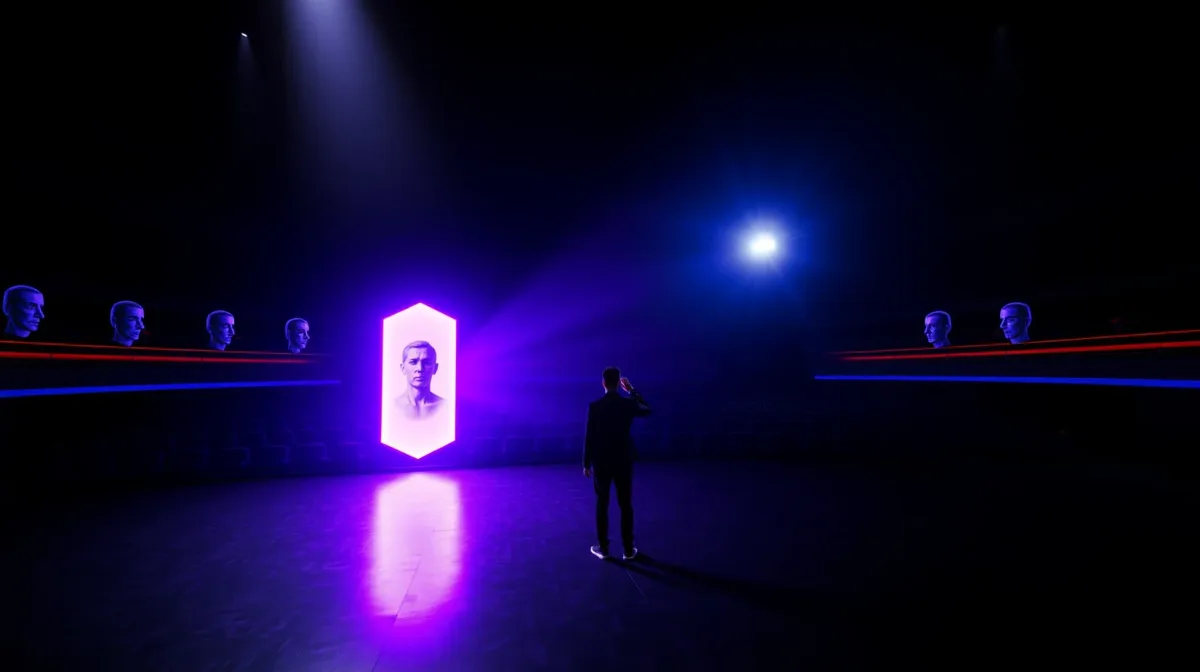
Actor Theater Dream: What Is This Identity Confusion Trying to Tell You?
Waking from a dream where you're an actor can leave you questioning who you really are. If you felt lost behind a mask or exhilarated by a new role, this dream taps into deep-seated issues of identity and authenticity. Let's explore what your subconscious is performing.
Dreams about being an actor often represent your feelings about identity, role-playing, and the masks you wear in daily life. It's natural to feel confused or detached after such a dream, as it frequently emerges during periods of personal transition or when you're adapting to new social or professional roles.
This aspect ties into the larger framework of theater dreams, focusing specifically on the performer archetype. Jungian theory suggests that actor dreams can reflect the anima/animus or shadow aspects, where you're exploring hidden parts of yourself. For instance, if you dream of an unrecognizable face, it might signal identity fragmentation. Yet, there's a positive spin: acting can also symbolize creative expression and the ability to adapt.
In your waking life, consider where you might be playing a role that doesn't feel true to you. Is it in your career, relationships, or self-image? The dream isn't condemning adaptation; it's highlighting areas where you could benefit from integrating different parts of yourself more authentically. By acknowledging this, you can move toward greater self-cohesion.
Dream Analysis & Interpretation
Deeper Psychological Analysis
Perspective-Shifting Question
What if the actor in your dream isn't hiding, but courageously trying on different versions of yourself to find which one fits best?
Deeper Contexts: Analytical Lenses for Your Dream About Actor Theater
Jung's Archetypes and the Actor
Source: Carl Gustav Jung, creator of analytical psychology
Self-Representation in the Brain
Source: Matthew Walker, sleep scientist and author of 'Why We Sleep'
What to Do Next: Relationship Map
Since your dream revealed identity issues often tied to social roles, this technique helps you visualize and adjust your relational dynamics.
- Draw the constellation: Place yourself in the center of a page and add people from your dream or real life around you.
- Mark the energies: Use colored lines—red for tension, green for support, blue for need—to connect yourself to each person based on how interactions feel.
- Read the pattern: Look for clusters of red lines; these areas likely correlate with where you feel forced to act or inauthentic.
- One change: Pick one relationship and brainstorm one small way to be more genuine in it, like sharing a true opinion or setting a boundary.
- Reflect weekly: Revisit the map to note shifts as you implement changes, observing how authenticity grows.
💡 Expert Tip:
This tool works because it externalizes internal conflicts, making abstract identity issues tangible and manageable.
What This Builds:
This builds relational intelligence and boundary-setting skills, essential for healthy relationships and leadership, by teaching you to align external interactions with internal truth.
Questions for Deeper Reflection
On a scale of 1-10, how authentic do you feel in your daily roles right now? What would need to happen to increase that authenticity by one point?
If you could drop one "act" or mask you wear, which would it be and why?
When have you felt most like your true self recently? What circumstances allowed that?
What Comes Next?
Frequently Asked Questions (FAQ)
What does it mean to dream about being an actor?
It typically symbolizes identity exploration, role-playing, and the masks you wear in waking life. It can reflect feelings of inauthenticity, adaptation to new roles, or creative self-expression during personal transitions.
Is dreaming about acting a bad sign?
Not necessarily bad. While it might highlight identity conflicts, it can also indicate psychological flexibility and the ability to navigate different social situations. It's a signal to check if your roles align with your true self.
Why do I dream about specific actors or characters?
Specific figures may represent archetypal qualities or personal traits you're integrating or rejecting. For example, dreaming of a confident actor could mirror a desired aspect of yourself you're learning to embody.
How can I stop feeling fake after an actor dream?
Focus on self-reflection: identify where in life you feel inauthentic and take small steps to be more genuine, such as expressing true feelings or adjusting roles that don't fit. Techniques like journaling or dialogue with dream figures can help.




Comments and User Dreams
Be the first to share your dream or opinion!