
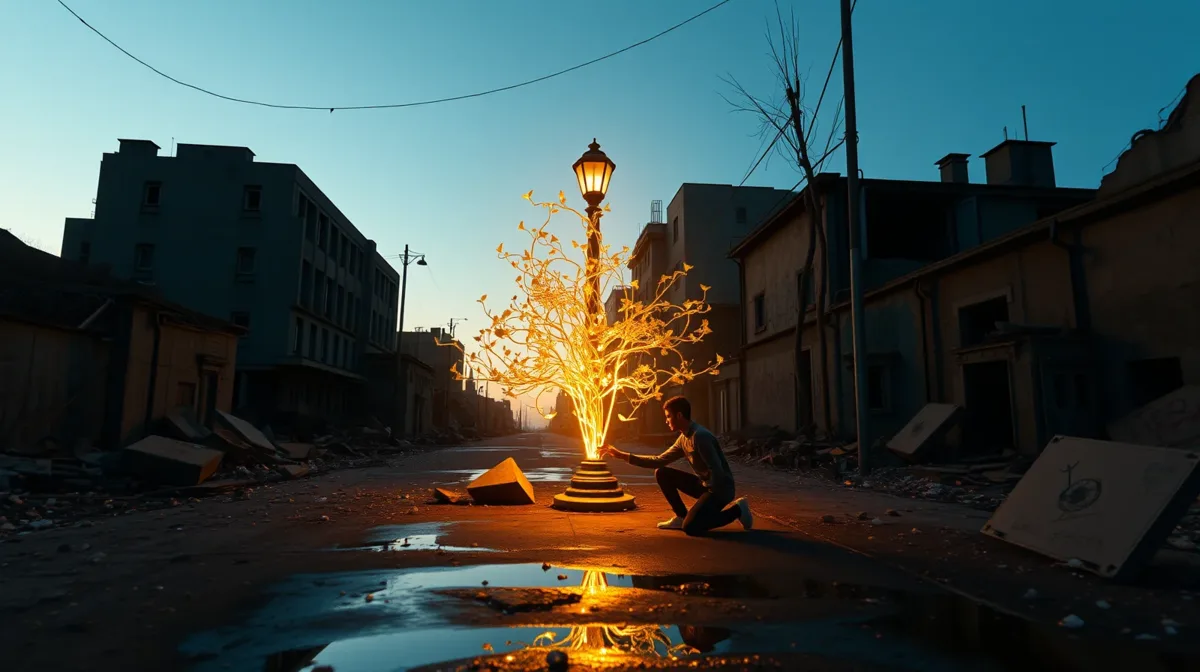
War Zone Dream: What Is This Chaos Trying to Tell You?
Waking from a war zone dream can feel like escaping a real battle. Your heart races, your mind replays explosions and screams. It's one of the most intense dream experiences—and it's more common than you think. War dreams aren't predictions; they're your subconscious amplifying inner turmoil. If your waking life feels like a battlefield—work conflicts, family tension, self-doubt—your mind uses the ultimate symbol of chaos to get your attention. This guide will help you decode the smoke and find clarity.
Dreaming of a war zone directly reflects a sense of being under attack in your waking life. You feel surrounded by conflict, unable to find safety or cease-fire. The specific details—who is fighting, whether you are a soldier or civilian—reveal how powerless or engaged you feel. This dream often emerges during periods of intense stress, such as a divorce, job loss, or ongoing family feud. It says: you are in survival mode.
Yet the war zone also carries a hidden message of resilience. As Jungian psychology suggests, this dream activates the warrior archetype—the part of you capable of enduring and fighting for what matters. The chaos may be clearing the field for transformation. Similar to dreams of a collapsing bridge or being stranded on a deserted island, this dream points to broken foundations. But dreams of war at their core are about reclaiming your power from external forces.
Consider where in your life you feel besieged. Is it a toxic workplace, a draining relationship, or an internal battle with anxiety? The specific setting may offer clues: an unfamiliar war zone suggests feeling unprepared, while defending your home indicates protecting your core values. Your dream is not predicting doom—it is mapping the territory you must navigate. The first step is to see the battlefield clearly.
Dream Analysis & Interpretation
Deeper Psychological Analysis
Perspective-Shifting Question
What if the war zone isn't a place of destruction, but a landscape being cleared for something new to emerge? Perhaps the rubble holds the foundation you need.
Deeper Contexts: Analytical Lenses for Your War Zone Dream
The Warrior Archetype
Source: Carl Gustav Jung, founder of analytical psychology
War in Mythology: Chaos and Renewal
Source: Joseph Campbell, mythologist and author of 'The Hero with a Thousand Faces'
What to Do Next: Rewriting the Dream's Ending
Your war zone dream left you feeling powerless. This technique puts you back in command—not by fighting harder, but by consciously redesigning the narrative.
- Recreate the scene. Close your eyes and return to the dream. See the chaos, hear the sounds. Notice where you feel most afraid.
- Pause time. Imagine you can freeze the dream at its most intense moment. Take a breath. You are safe in your room.
- Call an ally. Invite a figure of strength—a real person, a spiritual guide, or an imagined protector—to stand beside you. Feel their presence.
- Rewrite the ending. Now play the dream forward, but with one change: you are no longer a victim. Perhaps you broker a truce, find a hidden exit, or simply walk away unharmed. End the dream on YOUR terms.
- Anchor the new ending. Repeat this revised version until it feels as vivid as the original. Your brain will begin to associate the dream with empowerment, not fear.
💡 Expert Tip:
If the dream repeats, practice rewriting the ending just before sleep. You're training your subconscious to expect resolution, not chaos.
What This Builds:
This symbolic exercise builds real-world agency. By mentally rehearsing peaceful resolution and boundary-setting, you create neural pathways that make these responses more accessible in your daily life. The next time conflict arises, you'll have a blueprint for staying centered.
Questions for Deeper Reflection
On a scale of 1–10, how intense is the conflict in your waking life right now? What would it take to move one point DOWN toward peace?
When was the last time you felt completely safe and at ease? What was different about that period?
If you could declare a cease-fire in one area of your life tomorrow, which area would you choose—and what would be the first step?
What Comes Next?
Frequently Asked Questions (FAQ)
What does it mean to dream about a war zone during a period of peace at work?
Even when life seems calm, a war zone dream can surface inner conflict you've ignored. Your subconscious may be using the drama to highlight suppressed emotions, unresolved past trauma, or anxiety about future stability. It's a call to look beneath the surface of your waking peace.
Is dreaming of a war zone a sign of aggression?
Not necessarily. While it can reflect pent-up anger, more often it signals a sense of being overwhelmed by external pressures. You may be mismanaging conflict or avoiding necessary confrontations. The dream invites you to find healthy ways to assert yourself.
How is dreaming of a war zone different from dreaming of a battle?
A war zone is broader—it implies total environment of conflict, not just a single fight. It often represents systemic stress (family system, workplace culture) rather than a one-off argument. The dream suggests you are entrenched, not just in a disagreement.
What does a war zone dream mean for someone recovering from trauma?
For trauma survivors, war zone dreams may be the brain's attempt to process or relive past threat. They can signal that healing is needed but also that your psyche is actively working through the experience. Grounding techniques and therapy can help transform these dreams into less intense ones.





Comments and User Dreams
Be the first to share your dream or opinion!